

.webp)
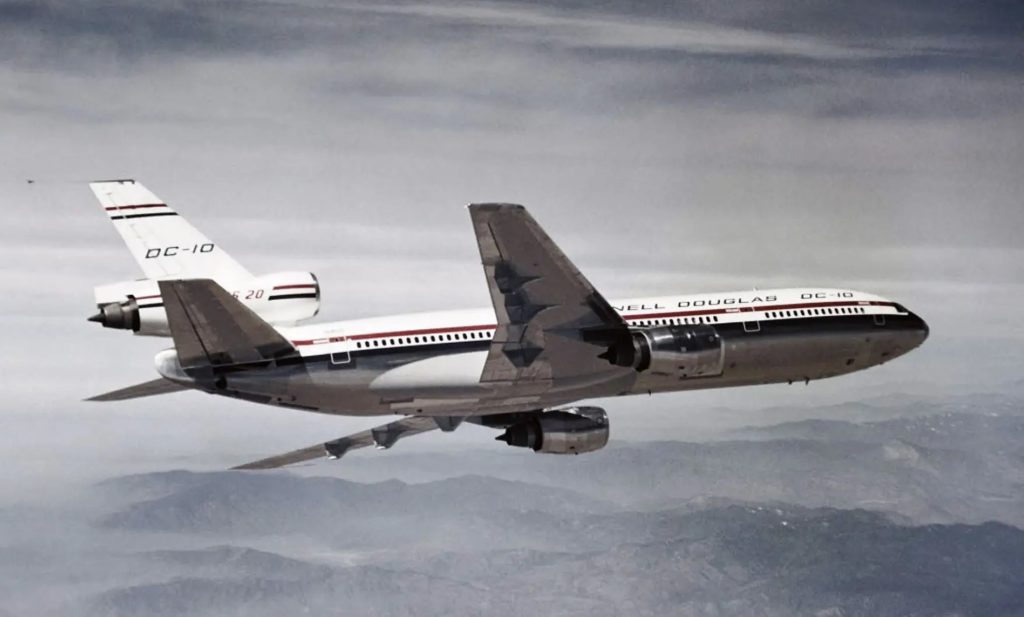
DALLAS — Today, in 1970, the McDonnell Douglas DC-10 made its first flight, lifting off from Long Beach Airport (LGB) in California and landing at Edwards Air Force Base, where the widebody trijet McDonnell Douglas developed alongside Lockheed's rival L-1011 TriStar began its flight-test program.
The prototype, registered N10DC, flew with company project pilot Captain Clifford Stout in command. A McDonnell Douglas film of the flight recorded the takeoff at Long Beach, chase-plane views over California, and the landing at Edwards. A detailed record of the flight lists Deputy Chief Engineering Pilot Harris C. Van Valkenburg as Copilot, John D. Chamberlain as Flight Engineer, and Shojun Yukawa as flight test engineer.
American Asked for a Twin, Douglas Built a Trijet
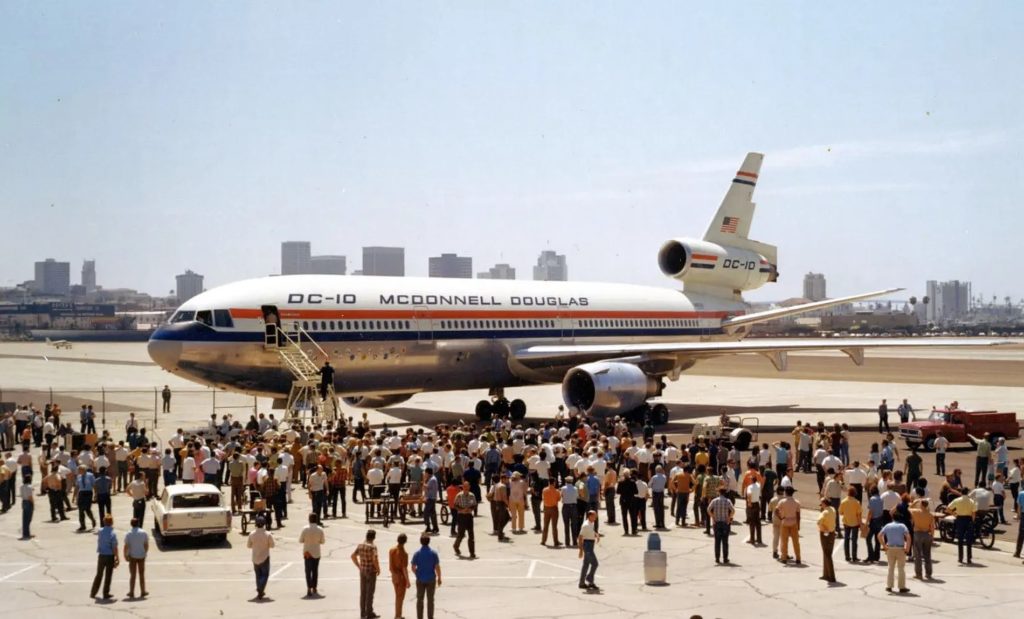
American Airlines (AA) set the program in motion in 1966 with a requirement for a widebody smaller than the Boeing 747 that could still fly long sectors from shorter runways. A design history of the program records the carrier's early criteria as a twin-engine aircraft carrying at least 250 passengers and 5,000lb of cargo 1,850 miles at Mach 0.80, out of the short runways at New York-LaGuardia (LGA). Douglas engineers proposed three engines instead, arguing that the layout would cost no more than a twin and perform better in hot weather.
American issued revised trijet requirements in July 1967, and the McDonnell Douglas board launched the DC-10 that November. The 1967 merger of Douglas Aircraft and McDonnell Aircraft had created the company, and its new management made the DC-10 a priority. American became a launch customer on February 19, 1968, ordering 25 aircraft with options on a further 25, and United Airlines (UA) followed two months later with 30 orders and 30 options.
From Rollout to Revenue Service
Douglas rolled the first DC-10 out on July 23, 1970, and flew it five weeks later. A flight-test program using five aircraft followed, and the Federal Aviation Administration (FAA) issued the type certificate on July 29, 1971, the same day the first two aircraft went to American and United.
American flew the type's first passenger service a week after that, on August 5, 1971, a round trip between Los Angeles (LAX) and Chicago (ORD) using N103AA. United followed on August 16 with a round trip between San Francisco (SFO) and Los Angeles.
The Series 20 That Became the Series 40
The Series 10 was built for transcontinental flying rather than intercontinental routes. The longer-range models were distinguished by a third main landing gear leg mounted on the aircraft's centerline.
Northwest Orient (NW) was the first carrier to order an intercontinental DC-10, in October 1968, and chose Pratt & Whitney JT9D engines for commonality with the Boeing 747s it had on order. That version was designated the Series 20 and redesignated the Series 40 before Northwest's first deliveries. The Series 30 used uprated General Electric CF6 engines.
The End of the Line
The DC-10 was in production from 1970 to 1988. McDonnell Douglas built 386 in passenger and freighter versions, along with 60 KC-10A Extender tankers for the US Air Force and two KDC-10s for the Royal Netherlands Air Force.
Biman Bangladesh Airlines (BG) flew the type's last passenger services. Its flight BG008 reached Birmingham (BHX) from Dhaka (DAC) by way of Kuwait City on February 20, 2014, and Airways was on board for the farewell flights the airline operated from Birmingham that weekend.
By late 2025, no DC-10 was left in regular passenger service, and the survivors were flying cargo, firefighting, refueling, and special-mission work. That November, the FAA added the DC-10, MD-10, KC-10A, and KDC-10 to an emergency airworthiness directive it had issued for the MD-11, citing similar engine-pylon structures. As issued, the directive prohibits further flight until an airplane is inspected and corrective actions are performed using a method the FAA approves. The agency said the directive was prompted by an accident in which a left-hand engine and pylon detached from an airplane during takeoff, and that the cause of the detachment was under investigation.
Featured image: Boeing


.webp)