

.webp)
LOS ANGELES — A taxi clearance tells a crew where to go. It does not remove the need to check whether the whole aircraft can fit through the space ahead.
On October 6, 2026, a Delta Air Lines (DL) aircraft and an Air Canada (AC) aircraft made contact at Los Angeles International Airport (LAX). CNN identified them as an Airbus A350 and a Boeing 777.
The Federal Aviation Administration (FAA) says Delta Flight 7 was taxiing for departure when its left wingtip clipped Flight 785's horizontal stabilizer, the horizontal surface at the tail. The Air Canada aircraft was under tow and had stopped short of its gate. The event occurred around 10:30 local time.
In its October 6 report, CNN said the 777 had arrived from Toronto and Delta's Tokyo-bound A350 had 275 passengers and 15 crew aboard. Air Canada spokesperson Sean Davidson told CNN the aircraft would be taken out of service for inspection and repairs; Delta's aircraft was also being inspected. Both airlines reported no injuries, according to Fox News Digital.
The FAA is investigating. Its preliminary account does not establish the cause. Understanding the ground-movement system helps explain what information is needed to reconstruct the encounter.
What a Taxi Clearance Covers
At a tower-controlled airport, taxi instructions establish an authorized route and any restrictions on movement. The FAA's guidance on taxiing says those instructions are based on known traffic and airport conditions. Pilots remain responsible for avoiding collisions with other aircraft and should seek clarification when an instruction is unclear.
Route authorization and physical clearance are separate considerations. A crew needs to understand the assigned path while monitoring traffic and obstructions along it.
Where Ramp Control Enters
An aircraft's trip between gate and runway can involve different control areas. The FAA defines the movement area as the runways, taxiways and other areas used for aircraft movement, excluding loading ramps and parking areas. At a tower-controlled airport, entry to the movement area requires approval.
Gate-area movements can involve a ramp tower. LAX's aircraft-operations rules require specific clearance from the FAA tower or ramp tower before an aircraft is taxied, towed or otherwise moved in operational areas. Someone in the aircraft or tow vehicle must communicate on or monitor the designated frequency.
A Tow Needs Authorization, Too
Pulling an aircraft with a tug does not exempt it from movement coordination. The FAA's towing guidance calls for advance tower approval before an aircraft is towed on or across an active taxiway or runway. It also calls for clearly defined communication responsibilities between the tow vehicle operator, cockpit observer when used, and ground control or ramp control.
LAX has a specific gate-arrival provision: an aircraft that begins turning into a parking position and stops before it is parked must be towed into the gate. That rule explains why a gate arrival may include a tow. It does not establish why Flight 785 stopped, or whether this provision governed its arrival.
The Aircraft Extends Well Beyond the Wheels
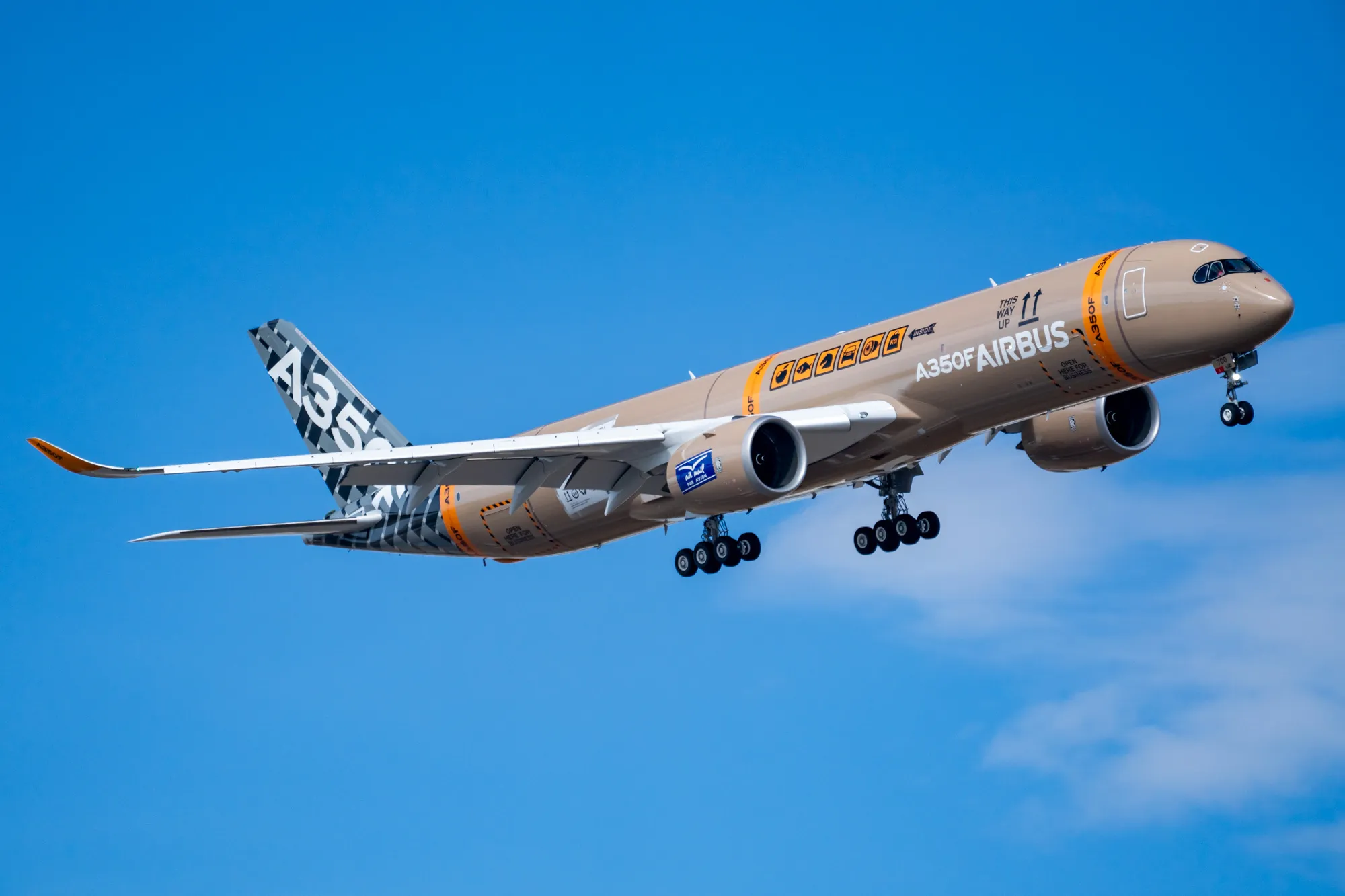
For scale, Airbus lists the A350-900's wingspan as about 212 feet (64.75m). Each wingtip is therefore roughly 106 feet (32.4m) from the aircraft's centerline. Those dimensions illustrate the space involved; they do not establish the variant or exact position of the Delta aircraft.
Airbus's airport-planning manual includes turning paths for the aircraft's extremities and a cockpit-visibility diagram. A turn changes where the wings and tail travel relative to the landing gear. Checking that the wheels fit on the pavement addresses only part of the aircraft's path.
Cockpit visibility also needs a qualification here. In its static-position diagram, Airbus says an A350 wingtip can be seen when the pilot moves their head to the side. Seeing a wingtip, however, is not a measurement of the gap between it and another aircraft. The diagram does not establish what either Delta pilot saw before contact.
A Centerline Is Guidance, Not a Clearance Guarantee
The FAA's taxiway-marking guidance makes an explicit distinction: keeping an aircraft centered over the yellow taxiway line does not guarantee wingtip clearance from other aircraft or objects.
The line provides a path to follow. Clearance still depends on the aircraft's dimensions and the space available alongside that path.
What Marshallers and Wing Walkers Do
A marshaller guides aircraft movement using standard hand signals. FAA towing guidance describes wing walkers as observers stationed at the wingtips to watch clearance and signal the tow operator immediately if contact threatens. The operator should stop until clearance is checked. It also recommends a tail walker during sharp turns or backing into a parking position.
At LAX, a wing walker must be positioned near each wing whenever an aircraft is pushed out of or towed into a gate.
Clearance Space and Runway Protection are Different
FAA airport-design standards provide object-free areas beside taxiways and taxilanes to protect wingtip clearance. Their dimensions account for aircraft wingspan, lateral deviation from the centerline and a safety buffer. The standards call for keeping parked aircraft and most other objects out of that space.
LAX's rules also prohibit parking an aircraft with any part extending beyond ramp or apron limit lines unless previously authorized. An aircraft's nose reaching the gate area does not establish that its tail is clear of neighboring traffic space.
The reported event is a taxiway ground collision. A runway incursion involves an aircraft, vehicle or person being incorrectly present in the protected area of a surface designated for takeoff and landing. The FAA's published account does not describe such an entry. The terms should not be used interchangeably.
Reconstructing the LAX encounter requires the full taxi and tow instructions and readbacks, the control boundaries in effect, and both aircraft's positions relative to the applicable clearance space. The ground team's presence and observations also need to be established. The FAA's preliminary statement doesn't give us that sequence or explain why the triple-seven stopped.
Alas, while aircraft inspections can establish the damage, a stopped tow and wingtip contact alone do not establish which action or condition caused the collision.
Featured image: Mik Hapte/Pexels



.avif)