
.webp)

MONTRÉAL — Air Canada (AC) operated its first-ever revenue flight with its brand-new Airbus A321XLR on Tuesday with a short hop between Montréal (YUL) and Toronto (YYZ), and Airways got a front row seat.
C-GXLR, the first of 30 expected XLRs delivered to the Canadian flag carrier earlier this year, operated AC413 after gate festivities including speeches from Air Canada, Airbus, and Montréal airport executives, media aircraft tours, snacks, and a ribbon-cutting ceremony.

“The entry into service of the first Airbus A321XLR marks a transformative moment for Air Canada and the beginning of an exciting new era for our customers, industry partners, and colleagues,” said Executive Vice President and Chief Commercial Officer, and President of Cargo at Air Canada, Mark Galardo. “Today, we celebrate an aircraft that will unlock new destinations, improve service on existing markets, and enhance the onboard experience.”
After an initial week of domestic operations, the XLR will make its first flight across the Atlantic to Toulouse (TLS) on June 15, with Berlin (BER) and Nantes (NTE) also launching this summer from YUL, both new destinations for the mainline carrier, though Berlin-Tegel with low-cost subsidiary Rouge (RV). Two jets have been delivered so far, with 28 more expected by 2029. 10 were initially expected by the end of the year, but that number is likely to decrease due to delivery delays.
The Cabin
Air Canada has opted for a layout of 14 Signature Class lie-flat seats up front and 168 economy seats in the back, 6 rows of which are sold as “Preferred” seats with more legroom. The configuration, as far as the numbers go, is identical to that of the launch customer, Iberia (IB).
The airline opted for Collins Aerospace as its seatmaker for the XLR and Panasonic for the in-flight entertainment (IFE) systems. For Signature Class, they picked the Aurora business class suit, a herringbone (facing the aisle) style lie-flat pod. There are 7 rows of seats in a 1-1 configuration.
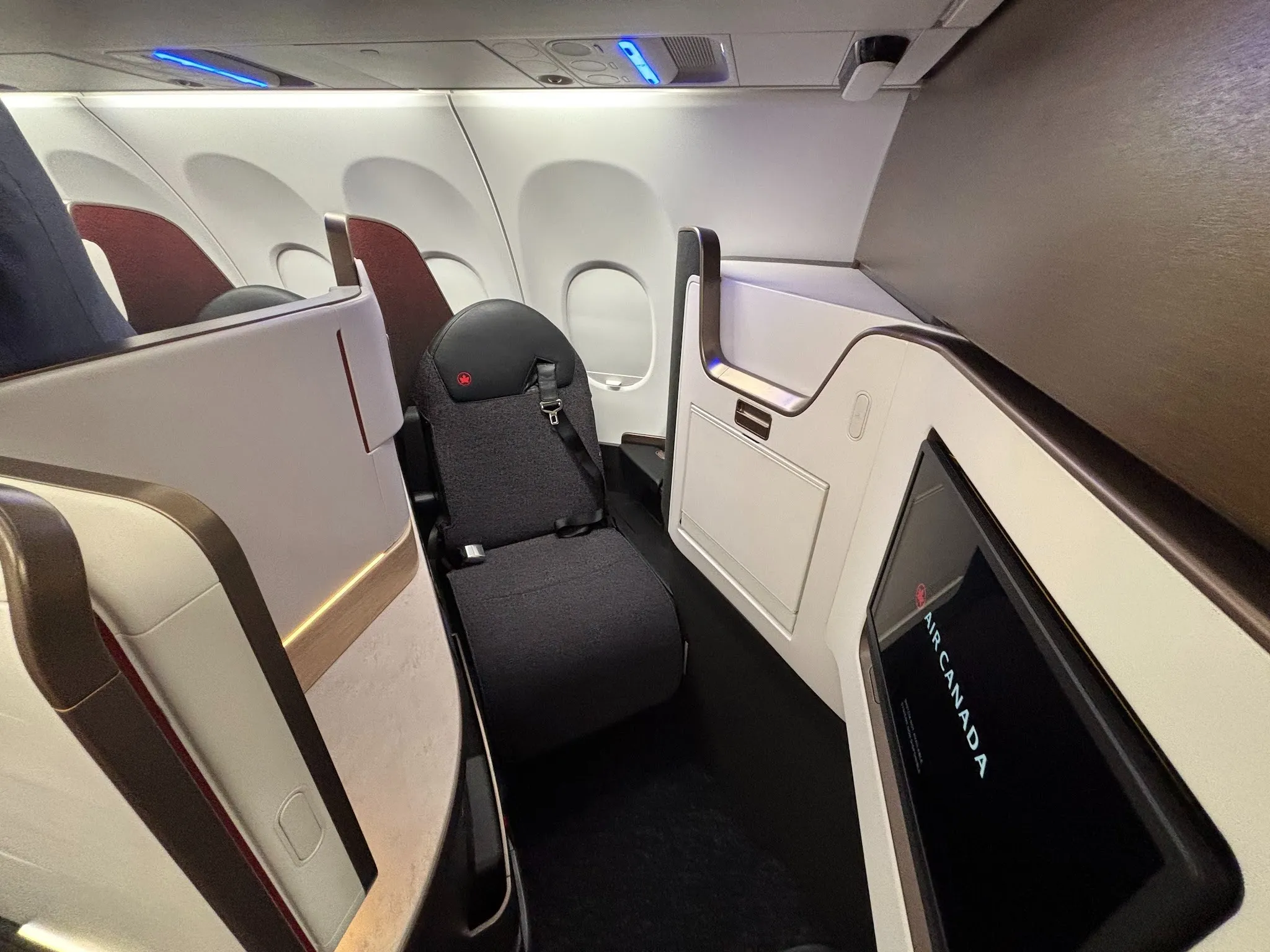
The new business seats feature Panasonic’s Astrova IFE system, a 19-inch 4K OLED display with Bluetooth audio capabilities that rotates from the side wall, multiple power options, including wireless, USB-C, and a universal outlet, a fold-out tray table, a tethered IFE remote control, and storage options throughout. Notably, they lack doors, unlike the 787-10 jets arriving later this year.
In Economy class, Air Canada opted for the Collins Meridian+ seat with the same Astrova IFE system, albeit with a smaller 13-inch screen. Beneath the screen, you will find a pair of headphone jacks and a pair of USB-C ports, physical volume controls, a light, a screen power button, and flight attendant call buttons.
Under the screen is a small drop-down shelf for small objects that also serves as a phone/tablet holder. The tray table is foldable, with both sides featuring a small cup indent, and the seat back pocket notably has three separate pockets: one for literature, one for larger objects, and one for smaller objects. AC outlets can also be found under the seat.

The Meridian+ seats will be making their way onto much of the mainline narrowbody fleet over the coming years as more A321 make their way from Rouge to mainline. A handful of these older jets already sport the new seats with the new Glowing Hearted design standard.
The new design elements make the cabin noticeably less monochrome than Air Canada cabins in recent years, and though often subtle, they pull their weight in making the cabin feel cozier and more Canadian.
The bulkheads up front feature a wood finish with bronze Air Canada and Signature branding. Signature Class seat partitions and many tactile elements are trimmed in bronze, walls behind the seats feature a deep red-black fabric fade, and surface tops are finished with stone texturing. Elements of red are also found throughout both cabins, from the economy seat cushions to the backs of storage compartments.

There are four lavatories on board: one in the front of Signature Class and three in the back. Two make up the rear right half of what otherwise would be a galley, which is condensed into the left half of the door area when facing the rear.
The third economy lavatory is placed on the right between the door and the last row of economy seating, but its door opens directly into a flight attendant jump seat. Not a great setup for the crew; however, this seat would only be occupied on trans-Atlantic flights, when there is the need for a fifth flight attendant, and a row of economy seats would be dedicated to flight attendants for rest.
The A321XLR
Air Canada placed its initial order for the A321XLR in early 2022 for 26 units, beginning deliveries in 2024. The order was later rounded up to 30, and after a few delays, the FIN 301, C-GXLR, arrived in Q1 2026. Deliveries are expected until 2029. The airline has already had two delivered, with the second arriving in Canada for entry work just last week.

Air Canada’s A321XLR fleet is powered by the Pratt & Whitney PW1100G Geared TurboFan (GTF) over the CFM LEAP-1A. While the GTF engines have had issues with supply chain constraints and low time-on-wing, which AC experienced on its A220 fleet, these problems have become less of a factor in recent years.
An A220 that Air Canada had grounded for years reentered revenue service, and of the 44 airframes delivered so far, only a handful are parked for maintenance or storage as of the time of writing.
The XLR’s GTF engines were very quiet, especially noticeable on the takeoff roll and initial climb. The whale howl, which has become iconic on the A220 and Embraer E2 in particular, is not as pronounced on the XLR, unfortunately for nerds like us.
With the Boeing 737 MAX jets heading to Rouge, the GTF engines will become the standard for Air Canada's narrowbody fleet, assuming no new orders or second-hand market activity. Air Canada is the second airline globally to fly the XLR with Pratt & Whitney engines after Wizz Air (W6), and the 5th airline to fly the type.
The day’s festivities
AC413, the inaugural Air Canada A321XLR flight, departed from gate 7 at YUL, which is where the day’s festivities in Montréal took place, though there were hints at something special throughout the terminal pre-security in the form of departure board ads and small banners.

At the gate, a large banner had been set up behind a red carpet to mark the occasion, along with cut-out props of the aircraft and a large boarding pass for photos, all adjacent to a table with themed sugar cookies, bottled beverages, and pistachio croissants.
A few members of the media were invited onboard to take photos before boarding, and the event got underway. Speeches were made by Air Canada Executive Vice President and CCO Mark Galardo, Aéroports de Montréal President and CEO Yves Beauchamp, and Airbus Senior Vice President Customers North America Colin Bole, who then cut the ribbon together.

Boarding commenced shortly after, with each passenger receiving a goodie bag containing a welcome card, an Air Canada water bottle, an A321XLR baseball cap, and a keychain. The flight itself was largely uneventful, without any special snacks, water cannon salutes, or speeches aside from a short mention in the welcome announcements.
All in all, it was a great day for flying and gave us a great look at the future of Air Canada, not just in the XLR but in the new cabin product that will make its way across the rest of the fleet. Exciting times are ahead for Air Canada and its passengers.
Stay tuned to Airways for more on Air Canada's A321XLR maiden flight.
Featured/All image: Jaedyn White/Airways



.webp)