
.webp)
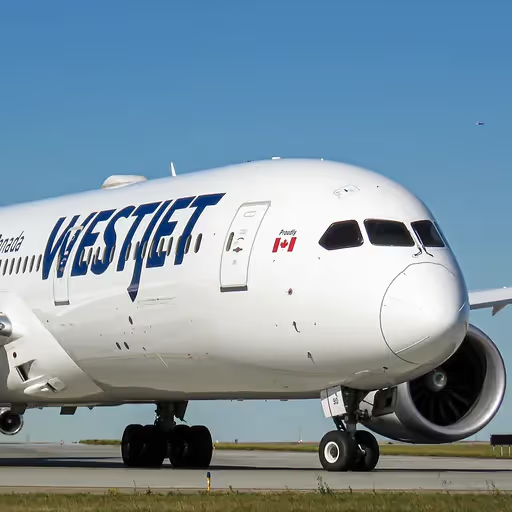
CALGARY — In the aftermath of an international media frenzy and a hefty share of public and staff backlash, leadership at Canadian carrier WestJet (WS) has reversed its decision to retrofit some of its Boeing 737 fleet with 180 seats.
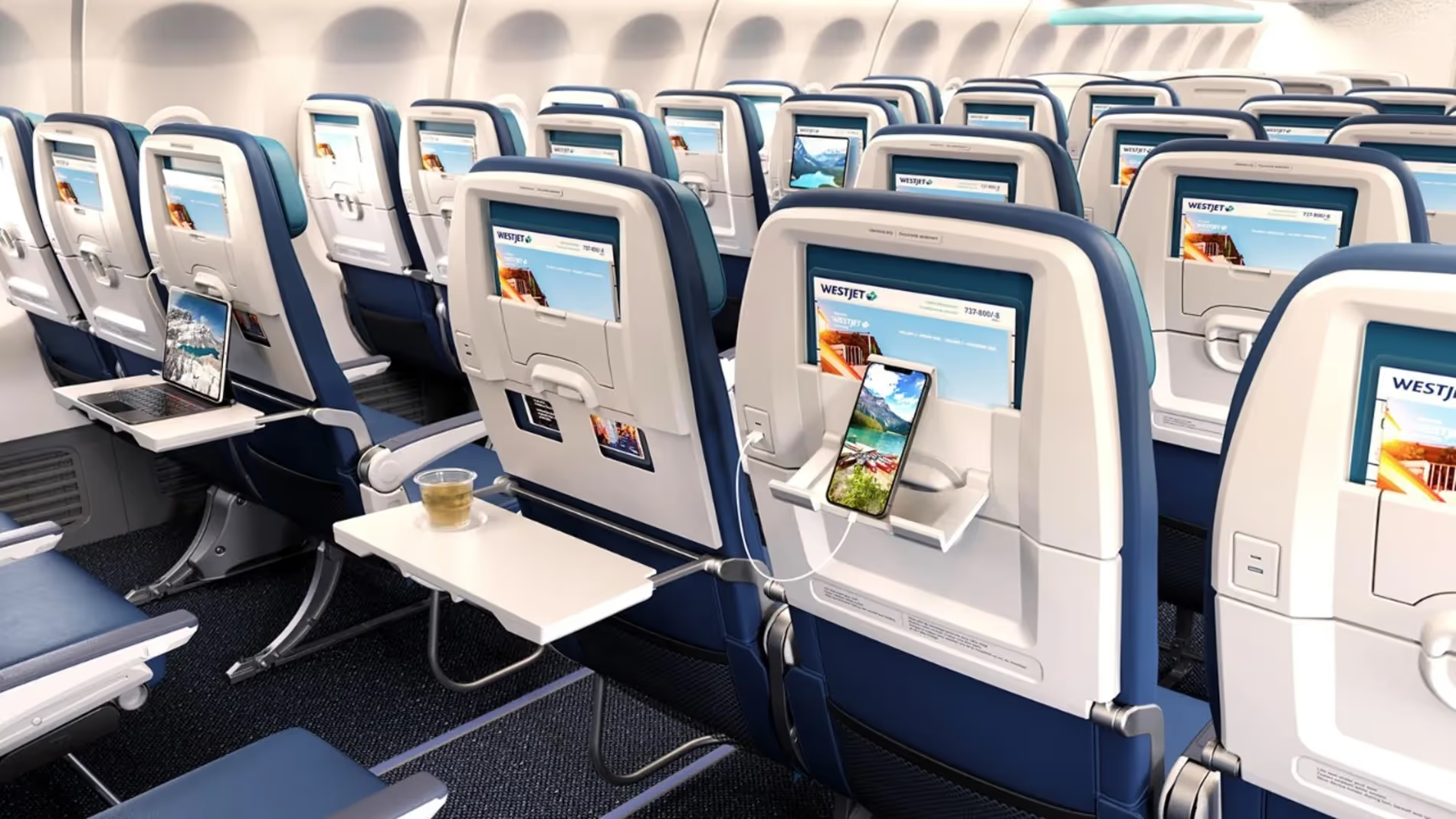
The backlash stemmed from the airline’s decision to reduce pitch to 28 inches for nearly all standard economy seats to accommodate an extra row, while removing recline for those same seats.
Currently, 23 Boeing 737-800 and 737-8 jets sport the new cabins, mostly former 189-seat Swoop (WO) and Lynx Air (Y9) aircraft, and two newly delivered -8s from Boeing. Originally, 43 aircraft were planned to receive the retrofits, with some new 737 deliveries from Boeing following suit.
The cabins feature 12 recliner domestic business class seats up front in a 2-2 layout and 168 seats in a 3-3 layout in the rest of the cabin, 36 (6 rows) of which are sold as “Extended Comfort” seats and feature recline, unlike the rest of the basic economy seats in the back. The previous cabins largely had the same layout, with one less row in the back: 12 business and 162 economy.
For context about the specifics of the cabins, see our article from September.
The Timeline
In September 2025, WestJet announced it would roll out new cabin offerings on 43 of its 737-800 and MAX 8 aircraft. These 43 jets were fitted with 189-seat all-economy configurations when they joined WestJet’s mainline fleet over the previous couple of years after they reintegrated their ultra-low cost subsidiary Swoop, scooped up defunct Canadian ULCC Lynx Air’s fleet, and merged with leisure carrier Sunwing.
Following the announcement, WS was put in the global spotlight as news broke that the standard economy cabin would not feature reclining seats. Headlines were made both in Canada and the United States, on the news, morning shows, and even during the Meanwhile segment of The Late Show with Stephen Colbert, the latter of which WestJet responded to in a post on Instagram featuring CEO Alexis Von Hoensbroech sending a package, saying, “When @stephenathome says your name on national TV, you send merch. IYKYK.”
Beginning back in May, 1 former Lynx Air 737-8 (C-GUUL) was fitted with the new cabin in Edmonton (YEG). The new offering began flying passengers in late October, while 20 more aircraft went for retrofits from then until December. When all was said and done, 6 of 9 Lynx Air tails were complete along with 15 Swoop tails (all except 1 -800).
By mid-December, backlash had grown among both customers and crews. The Air Line Pilots Association (ALPA), the union representing pilots at WestJet and WestJet Encore, publicly stated that it strongly opposed the decision to remove recline and reduce legroom. WS has announced a cabin reconfiguration that will boast some of the smallest seats in Canada, featuring 28” of seat pitch and non-reclining seats. We oppose this initiative for both our guests and crew members.” Emphasis was also put on the fact that pilots will, in many cases, be forced to deadhead in these cabins.
Meanwhile, the Canadian Union of Public Employees (CUPE), which represents WS flight attendants and whose collective agreement expired in the new year, began an ad campaign during bargaining, saying in one spot, “Flown WestJet? Now you're part of the Ultra Extra Basic Club. Just like WestJet Flight Attendants, you’re getting less for more… You’ll get exclusive perks like surprise fees and shrinking legroom…”
This culminated in the decision to pause the retrofit program, to, what WS says, collect passenger feedback over the peak winter season. During that time, a pair of factory-fresh Boeing 737-8s were delivered from Boeing with the new cabin configuration, bringing the total up to 23 planes.
Finally, over the holiday season, a video surfaced of a family travelling from Edmonton (YEG) showcasing the lack of legroom in the 28-inch pitch section of the economy cabin. The video, posted to Instagram by Amanda Rae, garnered 1.5 million views and brought the cabins back into the spotlight in national news.
Outrage continued to grow until finally, today on January 16, it was announced in a video conference to employees and a public statement that the decision was made to revert back to 174 seats, removing 1 row and standardizing pitch to 30 inches, which is the norm throughout WestJet’s current fleet and the greater aviation industry. A timeline and other specifics have not yet been announced, but the Collins seats will remain going forward.
In a statement, WestJet CEO Alexis Von Hoensbroech said, "WestJet tried seat pitches that are popular with many airlines around the globe as they serve to provide affordable airfares. As an entrepreneurial airline founded on making air travel affordable to Canadians, it's in our DNA to try new products. At the same time, it is just as important to react quickly if they don't meet the needs of our guests."
It’s worth noting that WestJet is currently the only airline in North America that has 28 inches of pitch on a Boeing 737-800/-8. Even Allegiant Air (G4) has a minimum of 29 inches on their 737 MAX 8-200s with 190 seats. Additionally, WestJet operates some of the longest 737 flights in the world to Latin and South America, as well as several transatlantic flights from as far inland as Toronto (YYZ). These sectors can be up to 8 hours long.
Statements
WestJet
WestJet today announced it will change its cabin-configuration approach for the limited portion of its fleet that has densified seating. Following a review of operational data and guest and WestJetter feedback, the airline will return to its prior standard seat pitch for economy cabins on these recently reconfigured aircraft by removing one row of seats.
WestJet pioneered affordable travel in Canada through a low-cost airline model that was able to offer significantly lower fares to Canadians. Over the past three decades, WestJet has evolved to keep pace with Canadians' affordability, while expanding its network and product offering.
"WestJet tried seat pitches that are popular with many airlines around the globe as they serve to provide affordable airfares," said Alexis von Hoensbroech, WestJet Group Chief Executive Officer. "As an entrepreneurial airline founded on making air travel affordable to Canadians, it's in our DNA to try new products. At the same time, it is just as important to react quickly if they don't meet the needs of our guests."
WestJet had paused reconfiguration plans in December and planned to finalize its evaluation of the new interior layout mid-February; however, the airline has now accelerated the review to address feedback and provide clarity sooner.
The move reflects the airline's commitment to aligning product decisions with guest needs while continuing to invest in reliability, affordability, and a modern onboard experience.
"WestJet was founded as an airline centred on guests," added von Hoensbroech. "It is in this spirit that we will take what we've learned and continue to be cost-disciplined and innovative, while staying true to what our guests and our people expect from us."
"It's also important to recognize our WestJetters who showed up for guests with care and professionalism throughout," said von Hoensbroech.
Aircraft interiors are managed to the highest safety and engineering rigor, with changes requiring multiple phases, starting with an engineering certificate. Once this certificate is received, WestJet can begin converting all 180-seat aircraft to 174-seat layouts, with completion timelines still being determined. WestJet is still evaluating other aspects of the new layout, while broader cabin reconfiguration investments, including refreshed interiors, enhanced amenities and modernized design, will continue as part of its commitment to improving the guest experience.
CUPE; Flight attendants union
CUPE 8125, representing over 4,700 Cabin Crew Members at WestJet and Encore, acknowledges WestJet's decision to reverse the universally unpopular new 28-inch-pitch seat configuration. This pause follows significant concern from both employees and guests regarding the operational impacts and overall experience resulting from the denser cabin layout.
"Our members have been telling us very clearly that these reconfigured aircraft led to increased tensions onboard, more frequent escalated interactions with guests, and significant physical and emotional strain," said Alia Hussain, CUPE 8125 WestJet Component President.
The union reminds the public that Cabin Crew are not responsible for corporate decisions. During the rollout of the new seat configuration, frontline employees experienced a troubling increase in guest frustration. That frustration, and even aggression, was too often directed at the very people tasked with maintaining safety and care onboard. Flight attendants were often learning about or experiencing the changes at the same time guests were.
"Our members do not design aircraft or determine service models," said Hussain. "Their role is to deliver safety, service, and professionalism in the face of ever-changing operational demands directed by the company."
CUPE 8125 has consistently emphasized that frontline experience must inform decision-making, especially when it directly impacts the travel experience. As the union enters the next stage of bargaining, it continues to advocate for decisions that prioritize people, both employees and guests, recognizing that long-term business success is built on that foundation.
"We remain hopeful that this signals a shift toward a more collaborative dialogue going forward," said Hussain. "When frontline realities are taken seriously, everyone benefits: the operation, the guest, and the workforce."
"We hope that WestJet will continue in this spirit and end unpaid work for our members. Canadians across the country agree that flight attendants should be paid for all their hours on the job, and we look forward to addressing this issue at the bargaining table."
CUPE 8125 is calling on WS to meaningfully engage with flight attendants and their union going forward, before making decisions that directly affect working conditions, passenger interactions, and onboard safety.
Featured image: Jaedyn White/Airways



.avif)