

.webp)
.webp)
Ancillary share leaders
Ancillary revenue share (%)
Frontier 62%; Spirit 58.7%; Breeze 54%.
DALLAS — For the average airline customer, the difference between a full-service carrier (FSC) and a low-cost carrier (LCC) starts and ends with the price of the ticket. One airline seems pricey but comprehensive, while the other appears cheap but disjointed.
The truth is, the difference is much more complex than that. The two airline models operate on two vastly different sets of principles, cost structures, network models, and risk profiles.
Over the last four decades, influenced by deregulation, economic downturns, and shifting consumer patterns, both models have developed, cross-pollinated, and gradually merged. However, their underlying ideologies continue to shape airline network utilization, crew training, route development, and airline survival during tough times.
The key difference between FSCs and LCCs lies in their strategic focus on profitability. While FSCs focus on network profitability, LCCs concentrate on route profitability.
An FSC like American Airlines (AA) has a hub-and-spoke system. Here, some routes are deliberately made unprofitable to generate traffic for high-revenue, long-haul, or full-service routes. A regional flight may be operated only to generate traffic for a high-revenue transcontinental or intercontinental route. Here, the focus is on connectivity, frequencies, and schedule building rather than route profitability.
On the other hand, LCCs assess each route separately. If a route does not meet their yield and load factor requirements, it is abandoned. Frontier Airlines (F9), for instance, keeps changing its routes seasonally. It enters and exits routes with little investment.
Fleet planning is one of the most apparent differences between the two business models.
LCCs use a single aircraft type, which maximizes scale economies in training, maintenance, and flight scheduling.
Using a single aircraft type minimizes the need for simulators, spare parts, and maintenance. Crew members are more versatile, and aircraft turnarounds are quick.
FSCs use multiple aircraft types to align capacity with demand on short-, medium-, and long-haul networks. United Airlines (UA), for example, uses narrow-body, wide-body, and regional jets on six major aircraft families. This allows for network flexibility but drives up training, certification, and maintenance expenses.
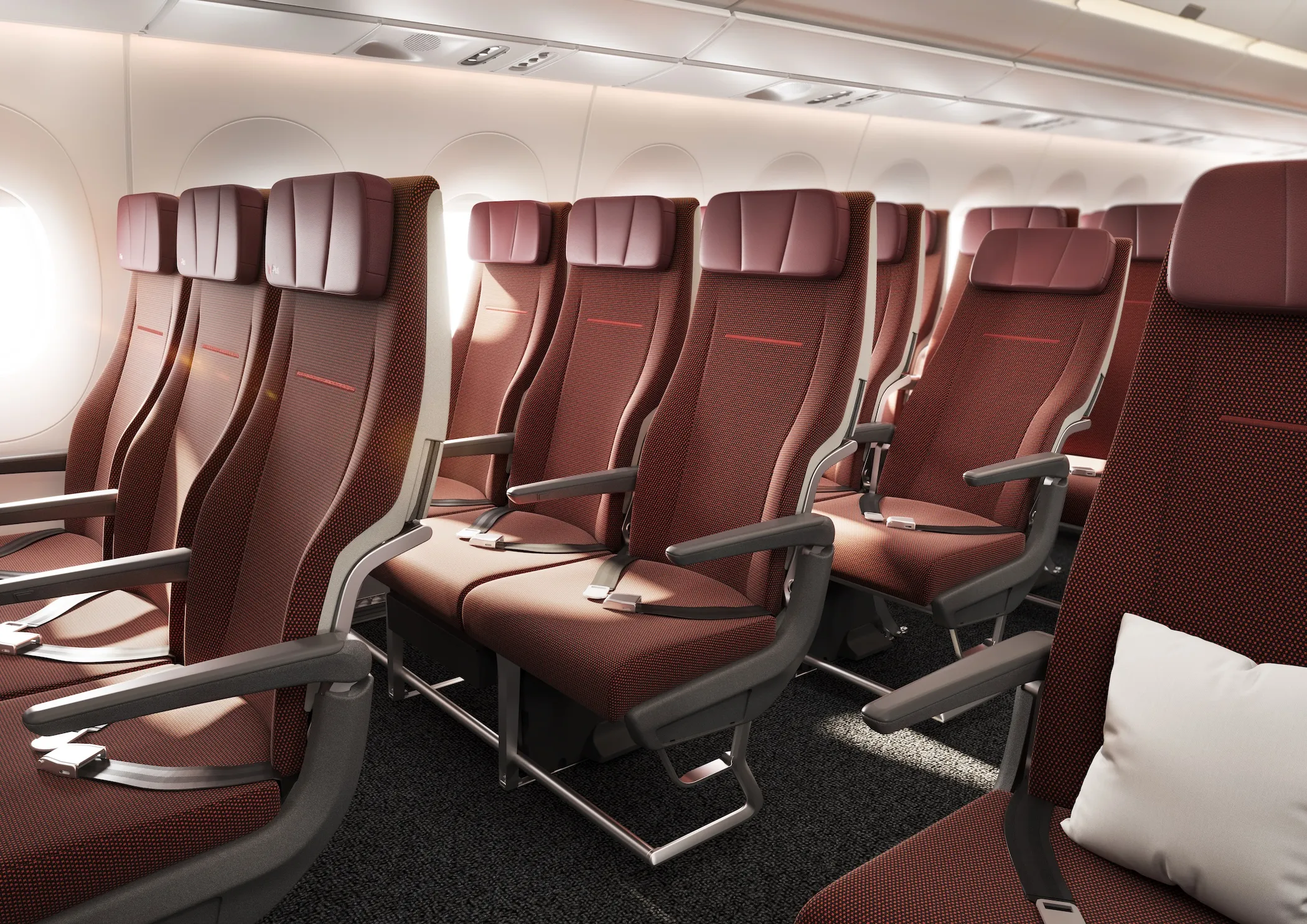
FSCs have traditionally provided a range of cabin classes: economy, premium economy, business, and sometimes first class, all within a single pricing structure. Baggage, airport check-in, seat allocation, and in-flight service are usually included, although this has been declining over time.
LCCs offer an unbundaged product. The basic fare will only cover transport; all else is à la carte. This enables price-conscious customers to pay less while allowing the airline to charge more to those customers who incrementally add services.
Airport choice is driven by cost sensitivity and brand differentiation. LCCs often choose to operate from secondary airports, which offer lower landing costs, lower handling charges, and less congestion. Examples include Ryanair (FR) operating from Paris Beauvais instead of Charles de Gaulle Airport or Jetstar (JQ) flying from Melbourne Avalon Airport instead of Melbourne Tullamarine Airport.
FSCs focus on hub airports, where network connectivity, high-quality demand, and alliance traffic justify the higher operating costs. These airports have better ground access and infrastructure, but at the expense of higher charges to airlines and their customers.
The distribution channels also differ significantly.
FSCs use various distribution channels, including global distribution systems (GDSs), corporate travel agents, and partners. This expands their reach but also raises distribution costs.
LCCs mainly use direct online sales, with the airline controlling prices and keeping distribution costs low. This helps maintain low costs and the unbundled pricing structure.
A key similarity among airlines is that labor and fuel costs are the largest expenditures.
FSCs incur higher labor costs due to their extensive services, ground handling operations, and complex business models. In 2019, labor costs accounted for 22-23% of total costs for British Airways (BA) and Iberia (IB), whereas for VivaAerobus (VB), they accounted for about 12%.
Labor costs are also influenced by the country's economic environment in which airlines operate. Carriers in countries with lower GDPs have lower labor costs.
Fuel costs are likely to be a relatively higher percentage of overall costs for LCCs, given their low-cost structure. LCCs are likely to have relatively new fleets, which enhance fuel efficiency. Fuel hedging is a key factor; Southwest Airlines (WN) is known to have saved more than USD$1.3 billion in 2008 by fuel hedging, while over-hedging led to substantial losses for IAG in 2020.
.avif)
Ancillary revenue is a key component of the LCC business model.
In 2023, global ancillary revenue exceeded USD$117 billion. At Ryanair (FR), ancillary revenue constitutes more than a third of overall revenue, as opposed to 15% at AA. Examples include baggage charges, seat selection, priority boarding, and in-flight sales.
FSCs generate revenue from diversified sources, including cargo, loyalty programs, and subsidiaries.
The split between FSCs and LCCs gained momentum after the 1978 U.S. Airline Deregulation Act, which ended government regulation of routes and fares.
The European airline market was liberalized in the 1990s, allowing LCCs to expand rapidly. By 2003, LCCs represented more than 20% of European capacity, up from 1.4% in 1996.
Southwest introduced the modern LCC concept, characterized by point-to-point networks, homogeneous fleets, and high aircraft utilization rates. Its cost management strategy enabled the carrier to remain profitable even in downturns.
Ryanair modified the U.S. LCC model to fit the European market, focusing on secondary airports and strict cost management to quickly build scale after EU liberalization.
Traditional carriers reacted to the threat of LCCs by launching low-cost subsidiaries, but with varying degrees of success. Some carriers failed due to incompatible cultures and costs, while others evolved into today’s hybrid carriers.
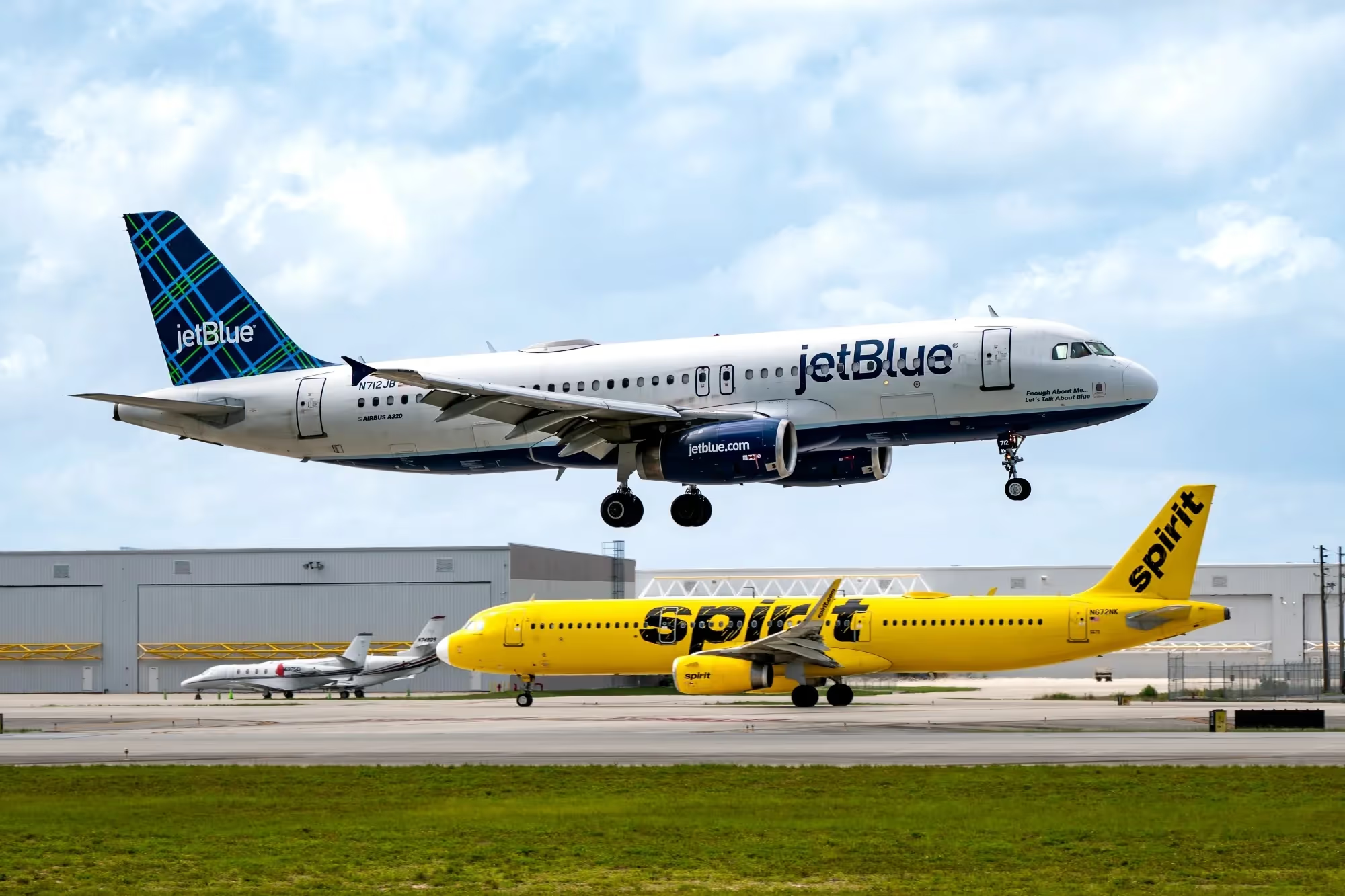
Today, the lines between FSCs and LCCs are increasingly being blurred. FSCs have introduced baggage and seat fees, while LCCs have introduced bundled pricing and loyalty schemes. Both are moving towards a hybrid business model that strikes a balance between flexibility and differentiation.
For example, JetBlue (B6) is best classified as a hybrid service carrier, blending low-cost budget fares with amenities typically found in full-service airlines. It offers free high-speed Wi-Fi, seatback screens, ample legroom, and premium "Mint" class on select routes, despite technically operating under an LCC model.
Full-service and low-cost airlines have evolved from different backgrounds, shaped by distinct assumptions about costs, connectivity, and customer behavior. Although their business models are different, the forces of competition and customer behavior are pushing them towards each other. It seems the future of the airline industry will be shaped by hybrids that can offer low prices as well as optional premium services.


.avif)