

.webp)
.webp)

DALLAS — You’re sitting by the window, watching the runway lights line up in front of you. The cabin has that hushed tension before landing—tray tables stowed, seatbacks upright, people glancing out as the wheels get closer to the ground.
Then, just as the concrete seems only seconds away, the engines roar louder, the nose pitches up, and the jet starts climbing steeply. A few gasps ripple through the cabin. You grip the armrest and wonder: what just happened?
The truth is, nothing went wrong at all. What you’ve just experienced is called a go-around, and far from being an emergency, it’s one of the safest maneuvers in commercial flying. Pilots train for it repeatedly, airlines plan for it on almost every flight, and air traffic control expects it as part of normal operations.
Still, for passengers, it feels strange. When I was on a flight to Mumbai (BOM) last month (about to land), I experienced a go-around and wasn’t surprised at all because the weather was a bit shaky; however, as soon as the engines spooled up, the passengers started screaming, chaos entered the cabin, and everybody started yelling at the pilots and cabin crew.
So what is it? Why would your pilots take that plane up in the air again when you just messaged your friends or loved ones that you’re landing? Let’s dive deep into what might seem strange or scary at first glance, but is actually intended for a safe operation of your flight.
Why Do Pilots Go Around? (Common Triggers)
A go-around (also called an aborted landing or missed approach) is simply an aborted landing on final approach. In practice, the pilot powers up and flies another circuit instead of immediately touching down. This maneuver is not a sign of pilot failure or panic – it’s a standard safety action when conditions aren’t perfect for landing.
Pilots initiate a go-around for many reasons. In practice, any time a landing is out of safe reach, the approach is aborted. According to airline experience, common triggers include:
- Unstable Approach – e.g., the aircraft is too high, too fast, or out of trim on final. If the plane won’t be in the touchdown zone correctly, the pilots go around.
- Weather or Winds – sudden wind shifts (gusts, wind shear) or powerful crosswinds can make landing unsafe. Low visibility (fog, clouds below minimums) also forces a go-around. For example, if pilots reach the decision altitude and cannot see the runway environment, regulations require an immediate go-around.
- Runway Incursion or Obstruction – any object on the runway (another airplane, vehicle, animal, etc.) is an automatic go-around. If ATC reports a runway incursion or the pilots see the runway isn’t clear, they will climb away rather than risk a collision.
- Traffic Spacing or ATC Instruction – In heavy traffic, a preceding plane may be slow to clear the runway, or ATC may need extra separation. Pilots routinely go around when instructed to do so by controllers. For instance, if one aircraft is slower or takes additional time exiting the runway, the jet behind will often abort its landing rather than risk getting too close. This happens all the time at busy airports when one flight “takes too long” and the following flight is already committed to land.
- Technical or Mechanical Issues – if a malfunction (engine indication, flight control problem, fire warning, etc.) appears on final approach, crews will execute a go-around to troubleshoot in the air. Modern airliners have strict limits (like “landing gear unsafe” or “critical flaps” fault) that trigger an automatic or immediate go-around.
- Pilot Judgment – sometimes a pilot simply feels the approach isn’t right (even if none of the above factors are present). Experienced pilots know it’s better to climb away than to attempt a risky landing. As one instructor puts it: “If the aircraft is too high, or we can’t land in the touchdown zone, or the wind’s too strong, we go around”.
Even if none of these occur, many airline crews list clear “go-around criteria” in their operations manuals: crossing checklists, speed and altitude limits, and visual requirements. If any go-around “go point” is not met, the landing is aborted.
.avif)
How Often Do Go-Arounds Happen?
Surprisingly, go-arounds are rare relative to the total number of flights, but they are not vanishingly rare. Data from the U.S. FAA (covering the 30 busiest U.S. airports) show about 0.39% of arrivals ended in a go-around in FY2023. That’s roughly one go-around per 250 approaches on average. (Unsurprisingly, mega-busy or tricky airports skew higher – Washington National (DCA) saw about 0.8% go-arounds, while Los Angeles (LAX) was around 0.2%.)
According to a travel blog that quoted FAA data, at these top airports, go-arounds occurred about 0.4% of the time in 2023. (Global rates are hard to pin down, but the author notes international averages are lower than the U.S. hub average.)
To put it another way, an average commercial pilot might land safely hundreds or thousands of times without a go-around, but seeing one occasionally is normal. Many airline pilots report going around only once a year or less on average.
One travel writer noted he personally experiences roughly one go-around per year on his passenger flights. In fact, surveys of pilots show most have done very few actual go-arounds in their careers. A European study (BEA/FSF) found 54% of air transport pilots had executed fewer than nine go-arounds.
However, go-arounds become more common during adverse weather conditions or periods of high activity. At some airports, dozens can happen in a single stormy day.
Notable Go-Around Examples
Go-arounds occur worldwide for various reasons, including weather, traffic, runway conditions, or ATC instructions. Some notable instances include:
- Heathrow 2022 (LHR): A British Airways (BA) A320 was on final approach when ATC noticed the preceding aircraft had not vacated the runway in time. The pilots initiated a go-around, safely climbing away from the runway, circling in the holding pattern, and successfully landing on the second attempt. Passengers reported hearing the engines spool up suddenly and felt the nose pitch up, but all remained calm after the captain’s announcement.
- Hong Kong 2023 (HKG): During Typhoon Saola, strong crosswinds and gusty conditions forced multiple flights, including Cathay Pacific (CX) and Hong Kong Airlines (HX), to abort their approaches. Pilots executed go-arounds, following strict safety protocols, and climbed steeply to reassess and approach the runway again once conditions stabilized. Passengers described the experience as dramatic but were reassured after the cabin crew's explanations.
- Newark 2021 (EWR): A United Airlines (UA) 737 aborted its landing when a vehicle unexpectedly entered the runway area during approach. The aircraft climbed safely, re-entered the traffic pattern, and landed about 15 minutes later without incident. This incident highlighted ATC vigilance and the crew’s prompt response in maintaining safety.
- Chennai 2025 (MAA): On August 10, an Air India (AI) flight from Thiruvananthapuram to Delhi was instructed by Chennai ATC to go around during its initial landing attempt due to suspected debris on the runway. The airline confirmed the maneuver was precautionary, and passengers were later reassured that no aircraft or safety systems were compromised.
- Chennai 2024 (MAA): On November 30, an IndiGo (6E) flight from Mumbai to Chennai aborted its landing amid severe weather from Cyclone Fengal. The pilots executed a textbook go-around to ensure the safety of the aircraft. A video of the climb went viral, prompting the airline to emphasize that such maneuvers are standard and underline the professionalism of their flight crews.
In all these cases, notice the common thread: a justified reason, a quick decision, and a controlled climb to safety. None of the examples were “mystery go-arounds” – the pilots had clear cues. Airlines analyze every go-around to learn, and often discover it was indeed the safest choice. As one expert blog put it, even in rare close-call situations, pilots do a “stellar job” when going around.
What Happens During a Go-Around
When a go-around is initiated, the flight deck immediately transitions to the missed-approach procedure. In modern jets (such as Airbus and Boeing), pushing the TOGA button or advancing the thrust levers to maximum directs the autothrottle or manual engines to climb power. The pilot flying adds about 10°–15° pitch to arrest the descent and begin climbing.
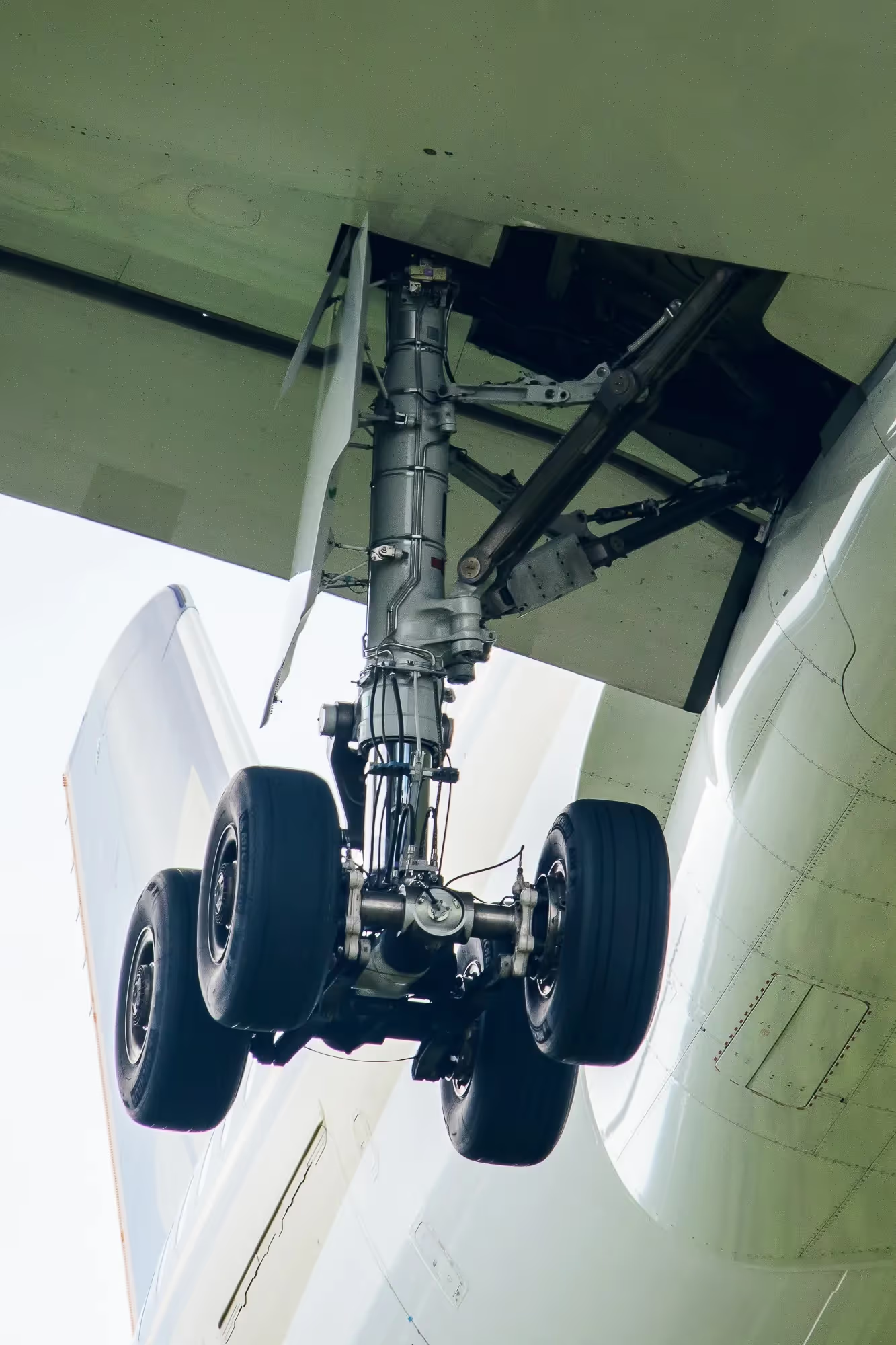
During a go-around, the landing gear is retracted as soon as a positive climb rate is confirmed, and the flaps are retracted stepwise (for example, from 30° to 15° and then to flaps up, as speed permits). The autopilot or flight director will track the specified missed approach heading and altitude. Meanwhile, the co-pilot (pilot monitoring) reads out the airspeed bugs and configurations, and calls ATC to request instructions.
If the go-around was due to traffic, the crew will advise ATC, confirm the new clearance (which is often an immediate turn and climb back to pattern altitude), and then rejoin the approach. If it was due to weather or an unstable approach, the crew may decide to hold or divert.
Often after a go-around, the flight will attempt the same runway again (as long as the issue is resolved), since a go-around by itself consumes some extra fuel but is thoroughly planned in the flight’s fuel reserves. In airlines, routine go-arounds rarely alter the flight plan significantly: the jet typically climbs back into the approach sequence and lands on the next attempt.
Pilots sometimes summarize the procedure this way: “Go around = TOGA, pitch up, configure (gear up, flaps up), fly the missed approach.” There’s a famous piloting phrase: “Go-arounds are take-offs” – meaning that the priority is to fly the aircraft safely, akin to powering up from the runway again.
Interestingly, some training guidance reminds pilots to consider the cabin: the flight attendants announce that “we have gone around and will try again,” helping passengers stay calm. But in the cockpit, it’s all business: throttle, climb, and then stabilize the climb.
A Pilot’s Perspective: Normal, Not Abnormal
To most airline crews, a go-around is simply part of the job, not a sign of poor performance. Pilots know not to take it personally. In fact, many veteran pilots say a strict rule in their airline is, “We won’t judge a crew for going around” — because it means they prioritize safety. One customer site quotes an airline captain as saying exactly that during a passenger question about an aborted landing. The point is, the vast majority of go-arounds are safe, planned events.
There’s even a saying among pilots: it’s better to have a smooth flight after a go-around than to land catastrophically by being too “greedy” for the runway. As a result, crews usually feel relieved, not embarrassed, when they make the right call.
That said, pilots do get “the butterflies” from time to time. Because the event is rare, some crews feel a moment of surprise. A common comment is, “Oh, we have a go-around – here we go.” Then quickly, all training kicks in. Simulator studies have found that crews who treat unexpected go-arounds as routine (using checklist discipline and good communication) manage them best.
So airlines emphasize crew resource management: the flying pilot calls the go-around (even a first officer can say “go around”), the non-flying pilot takes notes and catches altitudes, and they work as a team.
Airports where go-arounds are (or were) part of the landscape
Certain airports are renowned for go-arounds due to their unique geography, challenging weather conditions, or high traffic volumes.
- Kai Tak, Hong Kong (closed 1998): Legendary for its checkerboard approach over the city, Kai Tak had wind shear and crosswinds that forced many pilots to make last-minute go-arounds. Videos still circulate online of 747s banking low and then climbing out again.
- Princess Juliana, St. Maarten (SXM): Known for its beach-hugging runway, SXM often sees go-arounds due to shifting Caribbean winds or traffic timing. Watching a jet roar over Maho Beach, then suddenly pull up, is as dramatic as it gets.
- London Heathrow (LHR): With aircraft landing every 45 seconds on average, spacing is tight. ATC occasionally instructs go-arounds if a departure is slow to roll or an arrival hasn’t vacated the runway.
- Mumbai (BOM) and Dubai (DXB): Both airports experience high go-around rates during heavy monsoon or dust storm conditions. At BOM, rain and visibility are the main culprits, while DXB’s busy traffic, combined with desert winds, creates challenges.
- Hong Kong International (HKG): The modern airport still deals with strong crosswinds and typhoons. During storm seasons, go-arounds can happen back-to-back as pilots respect weather limits.
These airports demonstrate that go-arounds are not rare accidents, but rather accepted parts of daily airline operations.
The Numbers: Putting Go-Arounds in Context
Let’s recap some key statistics, with a global outlook:
- Frequency: Around 0.3–0.4% of commercial jet approaches end in go-arounds at busy airports (roughly one in 250). In quieter or smaller airports the rate is even lower.
- Pilots’ Experience: Over half of airline pilots have fewer than 10 real go-arounds in their entire careers, reflecting their rarity. Yet when they do occur, crews report, it’s usually due to meteorology, an unstable approach, or ATC instructions. About 30% of surveyed pilots said they’ve gone around while flying below published minima, which theoretically should be extremely rare, suggesting discipline in flying precisely to the book.
- Variation by Airport: Congested or constrained fields see higher rates. For instance, annual reports from Heathrow indicate that on the order of 800–1000 go-arounds occur per year (2022–23), significantly higher than the one or two per day in U.S. major hubs. Extreme weather days can push any field’s go-around count well above its norm.
- Pilot Training: About 85% of pilots feel well-trained for a go-around with an engine out, but nearly half admit they’re not as comfortable with a normal (two-engine) go-around. This has prompted recommendations to enhance the realism of simulator training for “aborted landing” scenarios.
Despite what the raw percentages might imply, every airline flight plan includes fuel for a few go-arounds if needed. Airlines allocate extra time and fuel to ensure that a go-around and second approach are routine. From an operational standpoint, a single go-around seldom disrupts a flight plan; it simply means the flight will land a few minutes later.
In Conclusion: Going Around is Going Right
In friendly, professional terms: Going around is safe. It’s also smart. For passengers, it might feel unsettling, but for the flight crew, it’s another chance to nail a perfectly safe landing. Modern airliners and crews treat go-arounds as part of the standard fabric of flying. Put another way, a routine go-around is the aircraft doing precisely what it was designed to do: respond to a changing situation by choosing safety first.
Pilots themselves often say: We’d rather circle and land safely than risk a hairpin come-down. That attitude is embedded in airline culture. And the statistics back it up: with roughly one go-around per few hundred flights at major airports, commercial aviation maintains an excellent safety record.
Go-arounds, far from being failures, are simply the altitude-off button we always have. They remind us that in aviation, as in life, the best plan is to be ready to pivot – and that every extra loop can keep everyone on board safe.
So don’t worry, the next time you experience a go-around, remember, your pilot’s there for you and he got this!”.
Stay tuned to Airways and follow us on LinkedIn and Instagram for the latest updates.
Featured image: Tantawat Homhuan/Airways



.avif)