Allegiant–Sun Country: A Leisure Power Play in a Fragmenting US Airline Market


.webp)

DALLAS — The proposed merger of Allegiant Air (G4) and Sun Country Airlines announced today may be the most strategically sound US airline deal in years. In a post-pandemic market where legacy carriers rely heavily on premium and international demand and ULCCs struggle with rising costs and uneven recovery, Allegiant’s US$1.5 billion bid for Sun Country aims to build on complementary strengths.
At first glance, the two carriers appear similar. Both operate point-to-point networks, target discretionary travelers, and avoid the complexity of hub-and-spoke systems. But the strategic logic emerges in their differences.
Allegiant (G4) has carved out a niche by connecting small and mid-sized US cities to leisure destinations through low-frequency flights. Its model depends on high ancillary revenue—about 45% of total revenue in 2023—and lower aircraft utilization than ULCC peers. The airline’s discipline is well known: if a route doesn’t deliver, it disappears.
Sun Country (SY), meanwhile, runs a more traditional leisure network centered on Minneapolis–St. Paul, with seasonal international flying to Mexico, the Caribbean, and Central America. But its defining feature is diversification. The airline’s Amazon cargo operation contributed nearly 30% of revenue in 2023, providing counter-seasonal stability that pure leisure carriers rarely enjoy. Charter flying adds another buffer against volatile summer fare environments.
Combined, the airlines would operate more than 190 aircraft and serve over 650 city pairs—a large footprint for a carrier focused almost entirely on travelers paying out of pocket rather than corporate accounts. In a US market increasingly split between premium-heavy network carriers and struggling ULCCs, the resulting merger creates a new, scaled leisure specialist with meaningful non-passenger revenue.
Financially, this is not a rescue merger. Allegiant has returned to consistent profitability, posting mid-single-digit operating margins and generating positive free cash flow. Sun Country remains profitable, though with thinner margins, and its cargo and charter segments have smoothed earnings across quarters. DOT Form 41 data places both carriers firmly in the mid-sized category—large enough to matter, small enough to stay nimble.
Operationally, DOT and BTS data show both airlines trailing network carriers in on-time performance—Allegiant around 72–75%, Sun Country around 74–78%—but benefiting from simple networks with minimal interlining. Delays create fewer cascading disruptions than at hub-and-spoke carriers. Importantly, route overlap between the two is minimal, reducing antitrust concerns.
Management projects US$140 million in annual synergies by year three, driven by fleet scale, more efficient seasonal aircraft deployment, and commercial integration. Crucially, the plan does not rely on labor concessions or aggressive network cuts.
Regulators remain the wild card. The DOJ has taken a hard line on airline consolidation, but this deal differs from recent blocked mergers: it doesn’t eliminate a national ULCC competitor, doesn’t increase concentration at slot-controlled airports, and doesn’t reduce competition in major business markets.
If approved, the combined airline would occupy a unique space in the U.S. market: a diversified leisure carrier with disciplined capacity deployment and a cost structure built for price-sensitive travelers. In an industry increasingly defined by extremes, this merger offers something rare—strategic coherence.
Whether it becomes a blueprint for the next generation of mid-sized carriers or a cautionary tale about the limits of leisure-first growth, the industry will be watching.
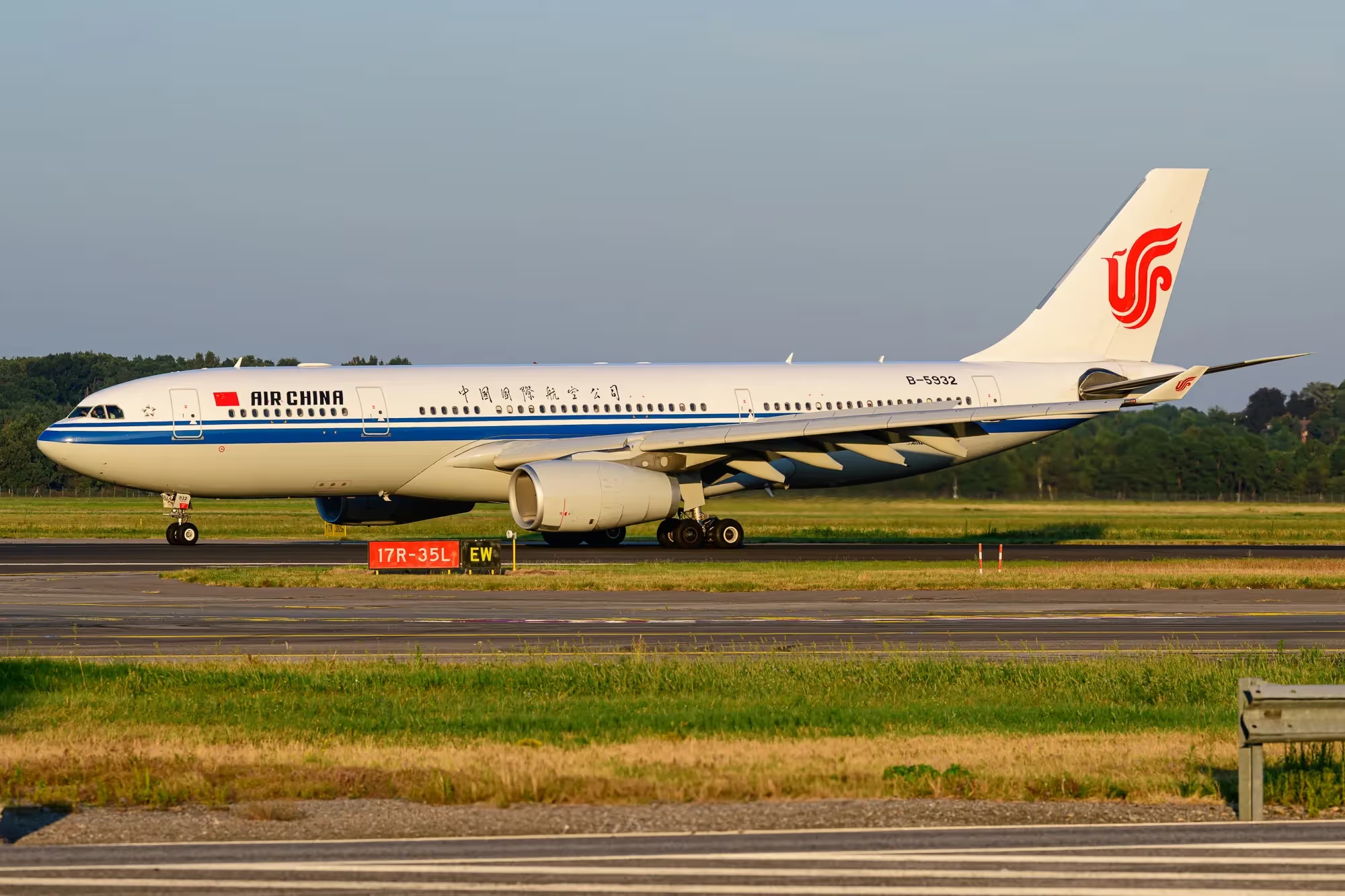
Feaured image: Jinyun Liu/Airways



.avif)