

How one former Flight Attendant and a group of caring women turned care packages into a nationwide labor of love
It began with a small group of kind-hearted women gathering once a month in Dallas to pack care packages for their college students. Gathered around kitchen tables, they filled boxes with treats and sent a little piece of home to their children.
Then, in January 2005, their leader, Nancy Carter, had an idea that would change everything. A former Delta Air Lines Flight Attendant, Nancy suggested the group shift its focus to another group of young people who were far from home—U.S. military men and women serving overseas.
That simple idea became Airborne Angel Cadets of Texas, an all-volunteer, nonprofit organization that sends thousands of care packages each year to service members stationed around the world.
What started with 15 to 20 women packing 25 boxes for their first adopted military unit has grown into an organization of approximately 100 volunteers. Seven times a year, volunteers gather for packing events, often joined by companies that bring 25 to 30 employees to help.
The numbers are impressive. In 2025, Airborne Angels sent more than 2,600 care packages containing more than 35,645lb of donated goods to troops in the Middle East, Africa, and Eastern Europe. The postage for these boxes was nearly US$70,000.
Behind every box is something more meaningful than a supply of toiletries and snacks. Each package is a tangible reminder to those in the service that someone back home is thinking about them.
A MISSION BORN ON A FLIGHT
For Nancy, supporting the military has always been personal.
As the daughter of a career Army officer and the mother of a member of the Merchant Marine, her life has been entwined with the military for decades. During her 40 years as a Flight Attendant, she also had the opportunity to work numerous military charter flights, during which she heard the personal stories of the men and women she transported.
One encounter, in particular, stayed with her. In 2004, Nancy met a young soldier on a flight to a war zone. He was just 19, nervous about what lay ahead. Trying to distract him and make him feel more comfortable, Nancy asked about his family and the care packages they sent him. His answer broke her heart. His family could not afford to send packages.
Nancy immediately thought of her own son and how much he enjoyed receiving the boxes she sent him. She knew that a package from home could mean so much to someone serving far away.
“I felt strongly about helping others feel that same connection while deployed,” Nancy recalls.
She never learned the young soldier’s name, something she still regrets. But she carried his story with her—and soon convinced her friends to add military care packages to their college packing days. That decision marked the beginning of Airborne Angels.
FROM 25 BOXES TO THOUSANDS
In the organization’s first year, the group sent 150 boxes to US military bases overseas. Since 2013, Airborne Angels has consistently shipped thousands of packages annually. Each is carefully packed to both maximize the supplies inside and make the most efficient use of the organization’s limited postage dollars. A typical shipment averages 350 to 410 boxes with a total weight of over 5,200lb. Each shipment can cost as much as US$10,600.
Since October 2025, the post office has increased postage costs three times. The increase that went into effect on July 12, 2026, raised the price of one box from US$26 to US$29. Larger boxes weighing 20lb went from US$22 to US$32 per box. Those are huge increases for the organization to absorb.
The heart of this work is not simply the number of boxes shipped. It is the thought and care that goes into making each one special and useful to the recipients.
PACKING WITH PURPOSE
The Airborne Angels' mission has always been to support service members stationed in war zones and other challenging locations where access to basic amenities can be limited.
At the start of the operation, most of the adopted units were in Iraq and Afghanistan. Currently, Airborne Angels sends to units in Iraq, Africa, and other countries in the Middle East; more so since the start of Operation Epic Fury, America's war on Iran. With war raging in Ukraine, the group also has units in Eastern Europe requesting support. Due to security concerns, Airborne Angels does not disclose the exact locations of its recipients or include military ranks on the packages.
The process begins when a military unit requests assistance. The group asks a series of questions to learn exactly what the service members need. How many people are in the unit? Are there military working dogs? Is there a microwave, coffee maker, refrigerator? Any restrictions on package size? What items are most difficult to obtain locally?
The organization also learns whether troops would appreciate supplies they can share with local children and schools. The goal is simple: Send what is needed and/or wanted most.
Each unit typically receives 70 to 80 different products to share among its members. If the requested items are not donated, Airborne Angels purchases them. Lovingly tucked inside every package are handwritten cards of encouragement—small but powerful reminders that the people receiving these boxes are not forgotten.
EVERY INCH COUNTS
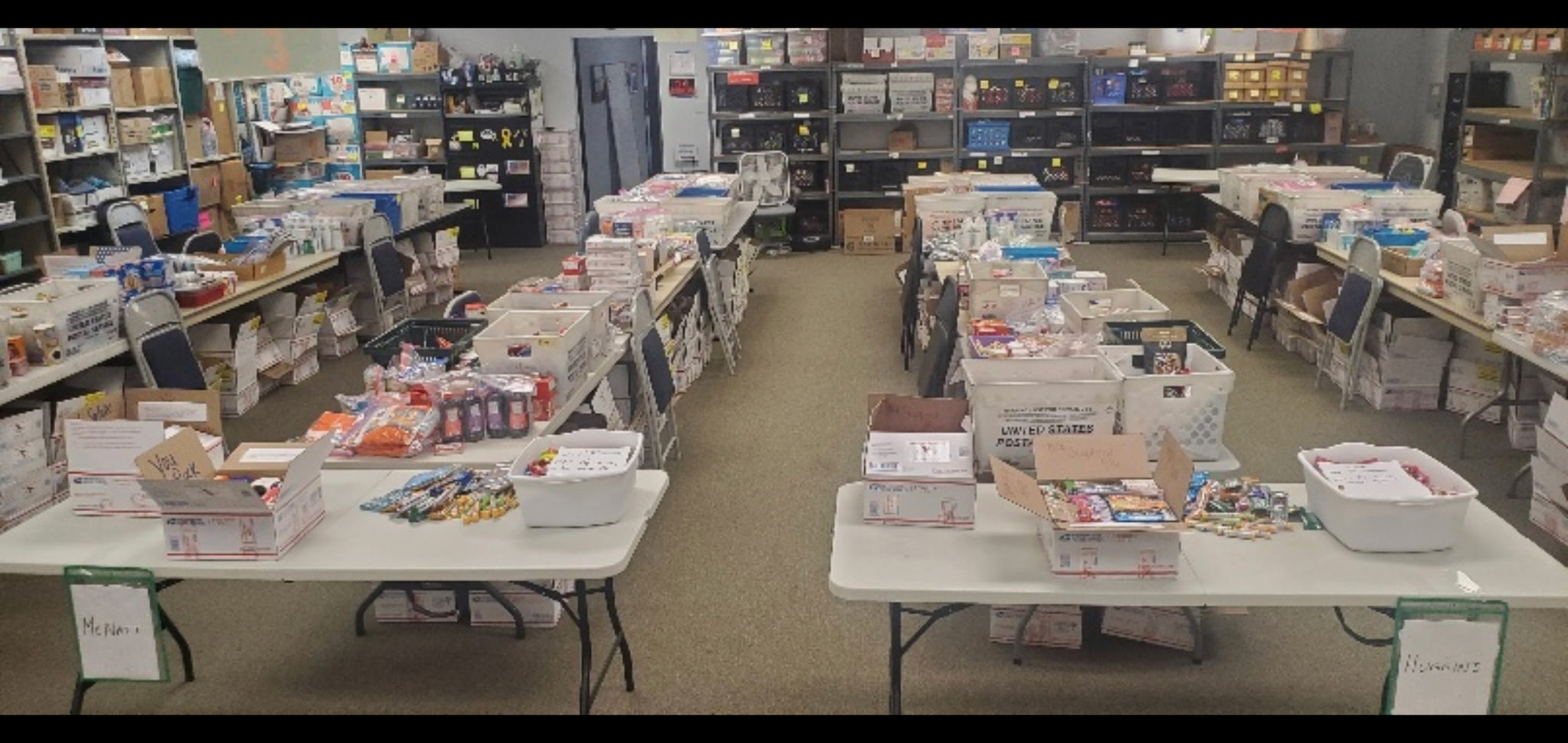
Packing thousands of care packages is a surprisingly precise operation. To keep shipping costs manageable, the organization pre-packs some lightweight but bulky items—including neck pillows, tissue boxes, flip-flops, cereal and cracker boxes, and feminine products—into larger brown boxes, keeping each under a 15lb limit whenever possible.
Liquids such as shampoo, lotion, and body wash are carefully taped shut and double-bagged to guard against leaks. Toiletries and food are packed separately to avoid contamination, while neutral items such as socks and playing cards can go anywhere.
Even the empty spaces are put to good use. Granola bars and loose candy are tucked into every nook and cranny, serving as both snacks and packing material.
Before a box leaves the facility, it is weighed, inventoried, assigned a recipient name, and numbered. Customs and postage labels are prepared, and each package is securely taped to withstand the journey ahead.
Depending on the destination, packages can take anywhere from one to five weeks to arrive. That is why they are mailed at least a month before a major holiday.
From start to finish, preparing for a single packing event takes about six weeks. As soon as one event ends, volunteers begin preparing for the next.
MORE THAN A BOX
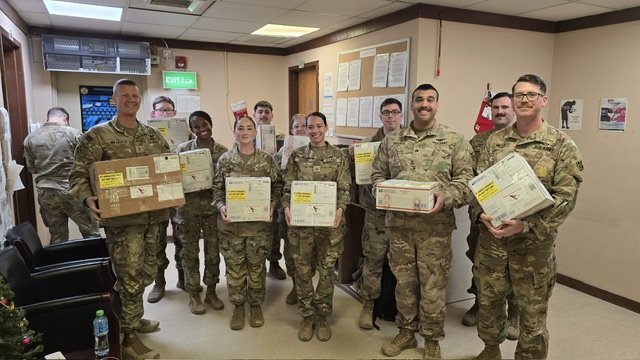
For the volunteers and supporters of Airborne Angels, the reward often comes in the responses that follow. Service members frequently reach out to express their appreciation. Their messages can be deeply moving, reminding everyone involved that the hours spent sorting, packing, taping, and shipping have a profound impact.
Some recipients have even traveled to Texas to meet the volunteers who had packed their boxes—and to thank them with a hug. Those moments are what makes the work so meaningful.
The Airborne Angels' supporters understand that a care package is about far more than the deodorant, lip balm, razors, coffee, batteries, or snacks it holds. It is about connection. It is a reminder of home. It is a message that says, “You matter. We remember you. We appreciate what you are doing.”
For the service members, that message can arrive from thousands of miles away, packed inside a cardboard box.
A MISSION THAT CONTINUES
Today, the need remains strong—and so does the commitment.
One of the organization’s biggest ongoing challenges is raising enough money to cover postage costs. Volunteers can collect and pack donated goods, but sending thousands of pounds of supplies around the world requires significant resources.
Still, Nancy’s original vision continues to grow. What began in 2005 with a small group of women and 25 care packages has become a remarkable community of volunteers, donors, and corporate supporters united by a simple belief: that those who serve the country should know they are not forgotten. And, every time an Airborne Angels package arrives at a remote military post, that belief becomes tangible. It is opened, shared, and appreciated.
Somewhere inside, among the toiletries, snacks, coffee, batteries, and other carefully chosen necessities, is something that cannot be measured in pounds or dollars—a little bit of home, sent with gratitude.
Written by Elise May. This feature appears in the November 2026 issue of Airways.
Featured image: Airborne Angels volunteers gather around a Delta Air Lines sign. Photo courtesy: Elise May